
Neck Pain from Desk Work in Brooklyn: Why Stretching Isn’t Fixing It (And What Actually Does)
You sit down at 9am. By noon, your neck is stiff.
By the time you close your laptop, it’s pulling toward one shoulder and your upper back feels like a concrete block. You stretch it out, maybe roll your neck, maybe book a massage.
It helps. For a day.
Then Monday rolls around and you’re right back where you started.
If that sounds familiar, you’re not alone. I see this constantly with desk workers in Brooklyn — and the honest answer is that stretching isn’t the problem. It’s just not solving the right problem.
Why Stretching Isn’t Working
Most people assume neck pain means tight muscles that need loosening. That’s not entirely wrong — but it’s missing the bigger picture.
Here’s what’s actually happening:
It’s a sustained load problem. Your neck isn’t hurting because you did something to it. It’s hurting because of the position your head has been in for 6–8 hours straight. Stretching addresses the symptom, not what’s driving it.
It’s a positioning problem. When your head drifts forward toward your screen — which happens naturally, without you noticing — it dramatically increases the load on your neck. Every inch your head moves forward adds roughly 10 lbs of effective weight your neck has to support. Do that for a full workday and your muscles are working far harder than they should be.
It’s a control problem. The small, deep muscles that are supposed to stabilize your neck gradually stop doing their job when you’re stuck in one position all day. The bigger, more superficial muscles pick up the slack — and they’re not built for that kind of sustained work. That’s where the tension comes from.
Stretching relaxes a muscle temporarily. It does nothing to change the pattern that loaded it in the first place.
What’s Actually Happening at Your Desk
Picture the position most desk workers end up in after a few hours of work.
Your head has drifted forward. Instead of sitting balanced over your shoulders, it’s jutting toward the screen. For every inch it moves forward, the effective load on your neck roughly doubles. By the time your head is 2–3 inches forward — which is common — your neck is managing the equivalent of a 30–40 lb weight instead of 10–12. All day. Every day.
At the same time, your shoulders have rounded inward. Your chest tightens. Your mid-back rounds and stiffens. This isn’t weakness — it’s just what happens when you stay in the same position long enough. Your body adapts.
The small stabilizing muscles in your neck and upper back quietly switch off, because your body has decided they’re not needed. The big movers — your upper traps, your levator scapulae — take over. They’re not designed for this kind of endurance work. So they fatigue, tighten, and eventually hurt.
That’s the tension you feel by 3pm. That’s what you’re trying to stretch out.
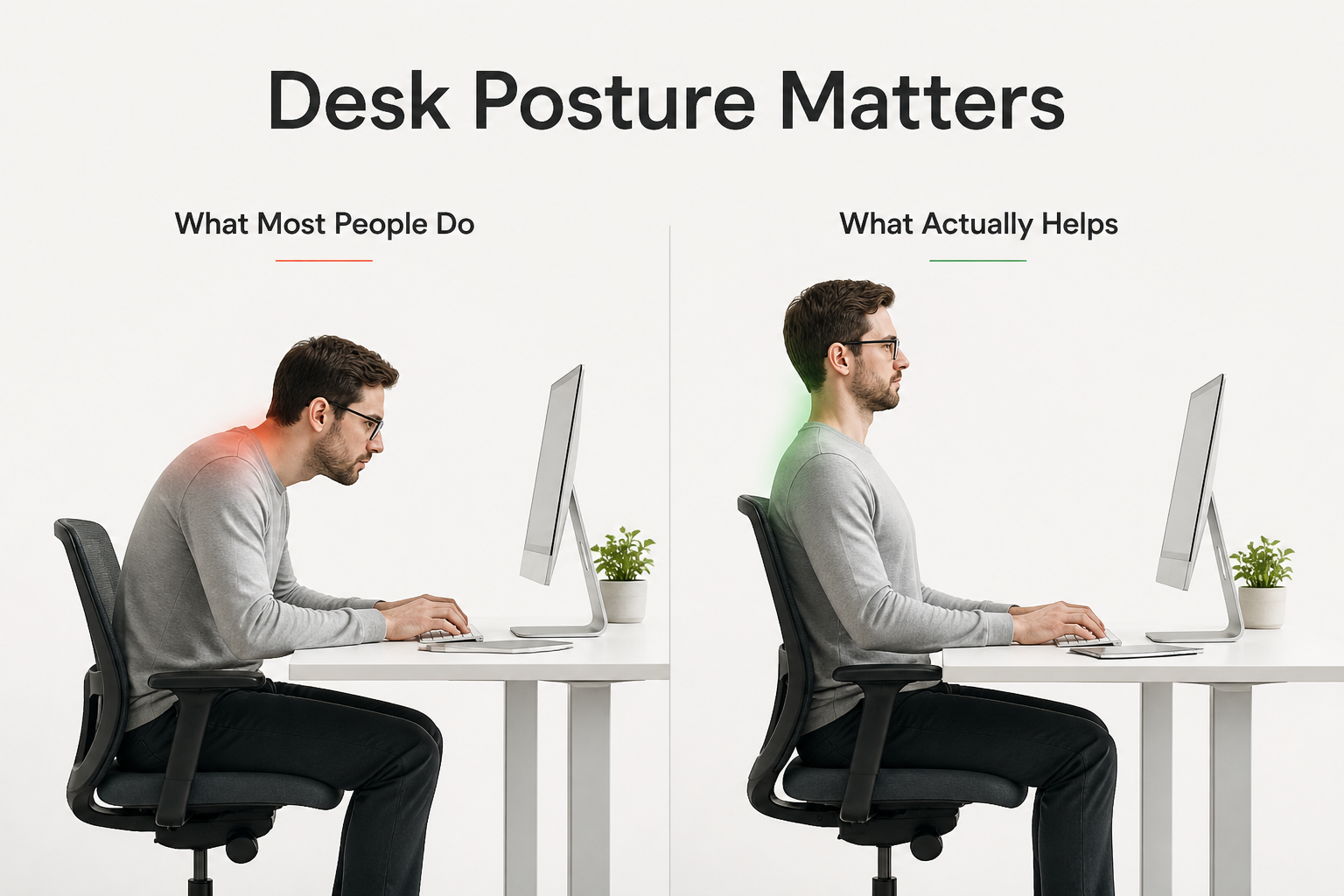
What’s Actually Going On in Your Body
Your body adapts to what you do most. Sit in the same position for 8 hours a day and your body stops treating it as a position — it treats it as the baseline. Normal.
Here’s what that means practically:
Your deep neck stabilizers stop firing because your body decided they weren't needed
The bigger, more superficial muscles take over all the load — and they're not built for it
Your neck and mid-back joints get compressed and stiff, and stay that way
You're not weak. You're not broken. You're just stuck in a pattern your body has decided is the default.
Stretching doesn't change that pattern. It interrupts it for a few hours, then you default right back.
What actually changes things is targeted movement — the kind that wakes those stabilizers back up and teaches your body a different default.
Stretching vs. Actually Fixing It
Stretching works by temporarily reducing tension in a muscle. And for a few hours, you feel better. But the moment you sit back down at your desk, the same load pattern kicks in. The same muscles fire. The same joints compress. The cycle starts over.
Movement and control work differently. Instead of just relieving tension, you're training the muscles that are supposed to be sharing the load to actually do so. Over time, your neck isn't working as hard in the same position. The tension doesn't build up as fast. The flare-ups get less frequent.
It's not a dramatic difference in what you're doing — it's a different goal. Symptom relief versus pattern change.
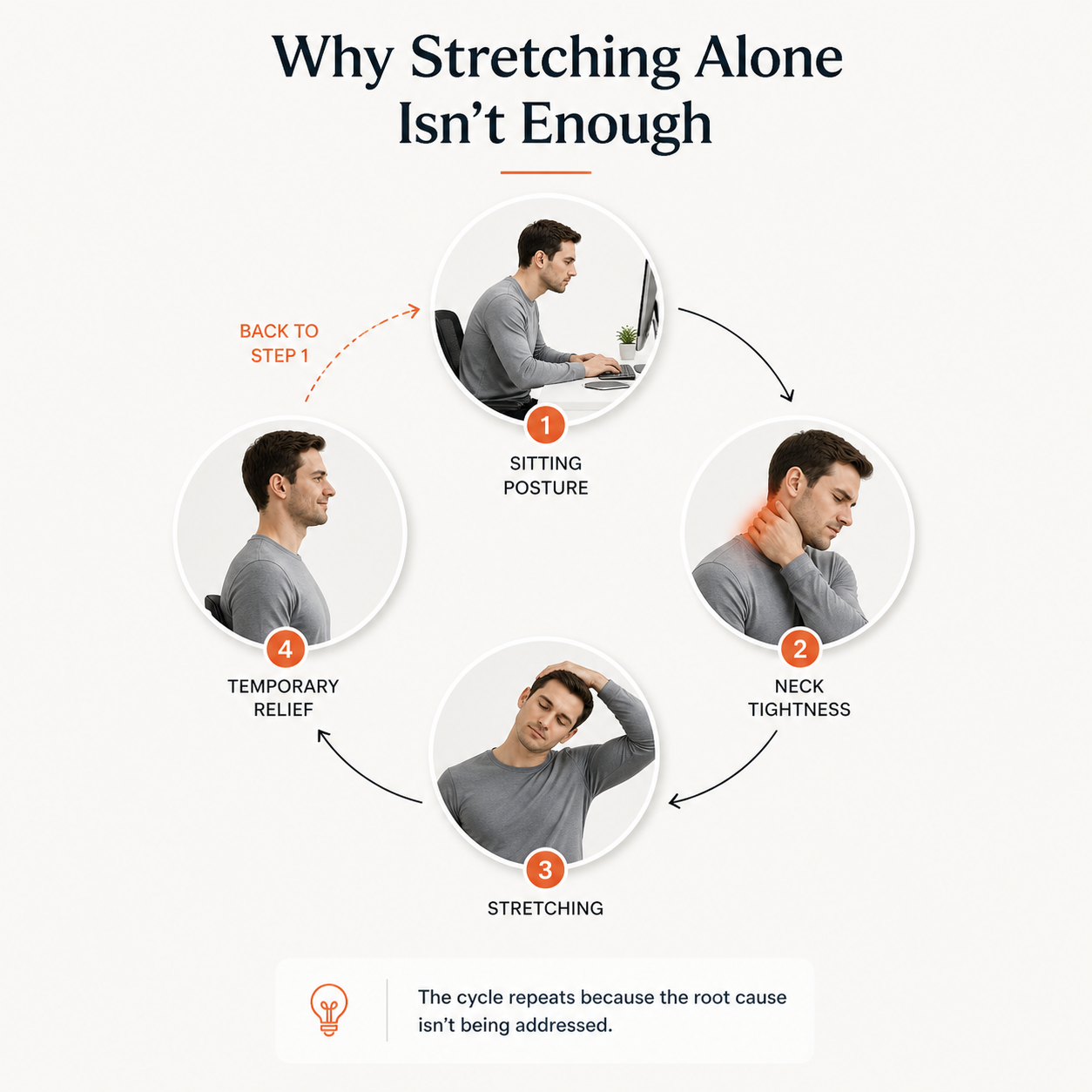
3 Things You Can Do Right Now
These aren’t a cure. But they’ll make a real difference if you’re consistent with them.
Posture Reset — Once an Hour
Don’t try to sit perfectly straight all day. That’s unsustainable and usually creates new tension.
Instead: once an hour, take 5 seconds to lift the crown of your head toward the ceiling and let your shoulders drop away from your ears. That’s it. You’re not trying to hold a perfect posture — you’re just giving your body a brief reset before it drifts too far.
2. Movement Breaks
Your neck doesn't hate your desk. It hates staying in one position for hours without a break.
Set a timer for every 45–60 minutes. Stand up. Walk to the kitchen, look out a window, do a lap around your apartment. Any movement counts. The goal is to interrupt the sustained load before it builds into pain.
3. Daily Exercises
Not a 20-minute routine. Two minutes, every morning, before you open your laptop.
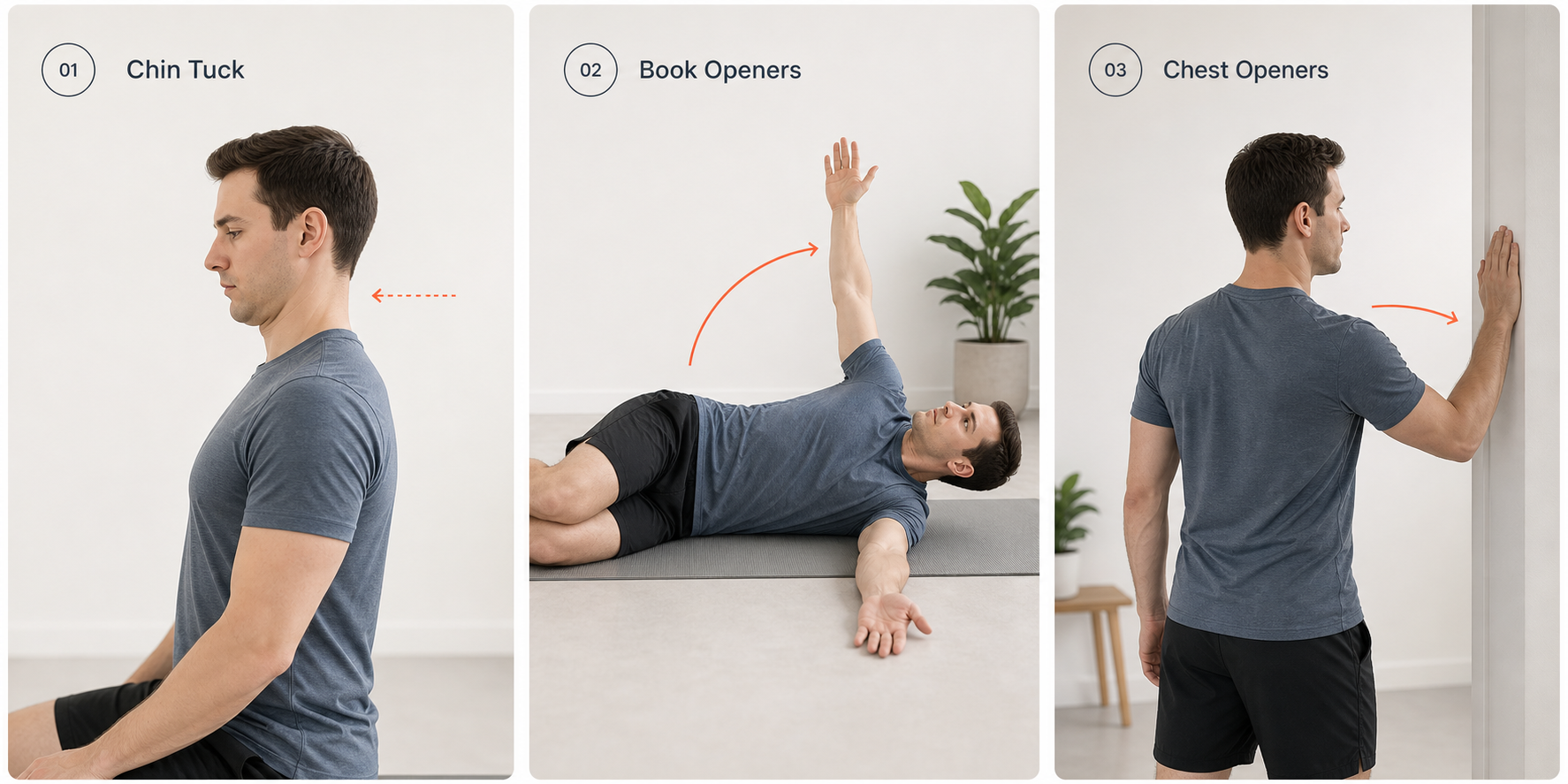
Chin Tucks Start seated or standing tall. Gently pull your head straight back — think ‘make a double chin,’ not ‘look down.’ Hold 2–3 seconds, then release. Keep your eyes level throughout. 10 reps. This reactivates the deep neck flexors that desk posture shuts off and helps counteract forward head position.
Book Openers Lie on your side with your knees bent to about 90 degrees, hips stacked. Start with both arms out in front of you, palms together. Keeping your lower body still, slowly rotate your top arm up and over to the other side, opening your chest toward the ceiling. Follow your hand with your eyes. Let your spine rotate — don’t force it. Come back slowly. 8–10 reps per side. This gets your thoracic spine moving and opens up the chest that’s been tight from sitting.
Open up your chest, improve shoulder mobility, and counteract desk-posture tension with prone chest openers.
This movement helps release tight pecs, reduce forward-shoulder posture, and improve thoracic mobility — making it a great warm-up drill for lifters, desk workers, and overhead athletes.
✅ Benefits
Loosens tight chest muscles
Improves shoulder external rotation
Helps correct rounded shoulders
Enhances thoracic mobility
Great for posture + upper body warm-ups
🧠 Technique Tips
Remember to keep chin back and chest up
2-3 rounds of 15 sec holds
The higher your hand, the deeper the stretch
When to Get Help
These exercises work well for most desk-related neck pain when the issue is primarily postural and muscular.
But some situations need more than a home routine:
It's not improving after 2–3 weeks of consistent effort
It keeps coming back — it goes away for a while, then returns with a trigger: a long day, a stressful week, a long flight
It's getting in the way — you're skipping the gym, turning your whole body to look left, or waking up stiff every morning
You have arm symptoms — tingling, numbness, or weakness anywhere from your shoulder down to your fingers
Those last two especially are signs something more specific is going on. You need someone to actually assess what's driving it — not hand you a generic exercise sheet and send you home.
We Work with a Lot of People Going Through Exactly This
Our practice is in Gowanus, right above CrossFit South Brooklyn on Degraw Street. If you're coming from Park Slope, Boerum Hill, Carroll Gardens, or anywhere nearby — we're an easy walk or bike ride.
We see a lot of desk workers with neck pain who've tried massage, adjustments, and stretching apps without lasting results. We also see athletes, runners, and CrossFit members who want to get ahead of this kind of thing before it sidelines them.
One doctor, start to finish. No rushed appointments, no handoffs.
This kind of neck pain is common. It's also very fixable — when you go after the right thing.
If It Keeps Coming Back, There's a Reason
Here's the thing most people don't realize: if you've been dealing with this for months — stretching, massages, maybe even adjustments — and it keeps returning, that's not bad luck or a bad body.
It means the treatment has been aimed at the symptom. The pattern that's driving it hasn't been touched.
That's not a criticism of anything you've tried. Massage feels good. Stretching helps in the moment. But neither one changes what your body defaults to when you sit down at your desk Monday morning.
That's a fixable problem. It just takes a different approach.
Book an Evaluation
If you want to actually figure out what's driving this, book a 60-minute movement evaluation. We'll look at how your body is actually moving, identify what's driving the pain, and give you a clear plan — not a generic one.
Most people leave with answers they haven't gotten anywhere else.
Functional Rehab · 597 Degraw St, Brooklyn · Above CrossFit South Brooklyn
Frequently Asked Questions
Why does my neck hurt after sitting all day? Sustained desk posture puts your head in a forward position for hours at a time. That increases the load on your neck significantly — your muscles end up working much harder than they should, and the deep stabilizers that are supposed to help gradually stop firing. By the end of the day, the muscles doing all the work are fatigued and tight.
Is it bad to crack or stretch my neck all the time? Occasional stretching isn't harmful, but if you're stretching multiple times a day just to feel normal, that's a sign the underlying issue isn't being addressed. The relief is real, but it's temporary. The pattern that's loading your neck resets the moment you sit back down.
How do I fix forward head posture? You can't fix it by just trying to sit up straight — that's not sustainable. What actually works is a combination of mobility work for your thoracic spine, activation work for the deep neck flexors, and regular movement breaks throughout the day. Over time your body learns a different default.
When should I see a professional for neck pain? If your pain isn't improving after a few weeks of consistent effort, keeps coming back after going away, is starting to limit what you can do, or you're feeling anything into your arm or hand — those are all signs it's worth getting assessed. Earlier is usually better.
Can this kind of neck pain go away on its own? Sometimes, yes — especially if it's a one-off flare from an unusually long or stressful week. But if you've had it for months and it keeps returning, it's unlikely to resolve on its own without changing something. The pattern that's driving it doesn't change just by waiting.